
Last updated October 15, 2026
Free written scope consultation - allowances, timeline, and change-order rules on paper before a single trade is scheduled
Construction Cost Breakdown: The San Jose Homeowner’s Reference for 2026
In San Jose, the gap between a low kitchen remodel bid and a high one often has nothing to do with quality. It has to do with whether the low bid includes permit fees, substrate repair, and material lead times, or whether those show up as change orders after demo day. A $22,000 kitchen bid that quietly excludes permits eats a $27,000 all-in bid for lunch once the city signs off and the rotted drywall behind the sink gets replaced. This guide breaks down actual line items for San Jose’s most common projects in 2026, explains what drives cost up or down in this market, and gives you a method for comparing two written bids without losing your mind. For more guides & resources, see our blog.
Quick Answer
A full kitchen remodel in San Jose runs $35,000 to $90,000 in 2026, a primary bathroom $22,000 to $55,000, a detached ADU $250,000 to $450,000, and a room addition $180 to $350 per square foot plus permit and design fees. Labor typically accounts for 40 to 55 percent of the total, materials 35 to 45 percent, and San Jose permit, plan-check, and inspection fees 4 to 8 percent. A legitimate written bid separates these line items; a bid that lumps everything into one number tells you nothing about where your money goes.
Styles & brands we work with







Table of Contents
- Kitchen Remodel Cost Breakdown: 2026 San Jose Numbers
- Bathroom Remodel Cost Breakdown: 2026 San Jose Numbers
- ADU Construction Costs in San Jose
- Room Addition Costs: Per Square Foot Reality
- The San Jose Permit and Plan-Check Layer Most Bids Omit
- Where San Jose Material Prices Beat the National Average by 15-30%
- Contingency Lines vs. Open-Ended Change Orders
- How to Compare Two Written Bids Line by Line
Kitchen Remodel Cost Breakdown: 2026 San Jose Numbers
San Jose kitchen remodels in 2026 typically land between $35,000 and $90,000 for a full gut with layout changes. A cosmetic refresh (new counters, refaced cabinets, backsplash, hardware) runs $15,000 to $28,000. The difference between the low and high end comes down to four drivers: whether the footprint moves, cabinet line choice, countertop material, and what condition the substrate (the structural layer beneath your finishes) is in once walls open up.
Here is what a mid-range, 180-square-foot San Jose kitchen remodel with semi-custom cabinets and quartz counters looks like line by line in 2026:
- Demolition and hauling: $2,800-$4,500. Includes debris removal, which costs more in San Jose due to city disposal fees and transfer station rates.
- Cabinet fabrication and installation (KraftMaid or similar mid-tier line): $14,000-$22,000. Custom cabinets push this to $30,000-plus; RTA flat-pack drops it to $6,000 but you lose installation warranty coverage.
- Countertops, including fabrication and templating: $4,800-$8,500 for quartz; $5,500-$10,000 for granite with a premium edge profile; $6,500-$14,000 for Cambria or Silestone with a waterfall island.
- Plumbing fixture replacement and rough-in adjustments: $2,200-$4,800. Moving a sink line adds $800-$1,800 depending on slab access.
- Electrical work: $2,500-$5,500. San Jose code requires GFCI protection within six feet of water; older homes frequently need a subpanel upgrade at $2,000-$4,000 if the existing panel is maxed out.
- Flooring (tile, LVP, or engineered hardwood): $3,200-$6,800 for 180 square feet installed.
- Backsplash tile and install: $1,200-$2,800.
- Drywall, texture, and paint: $2,000-$4,000. Includes patching everything the plumber and electrician opened.
- Permits, plan check, and inspections: $1,800-$3,500. More on this below, but the number is real and the city requires it.
That puts a real mid-range kitchen at $34,500 to $62,400 before you touch the contingency line. If a San Jose bid comes in at $18,000 for the same scope, someone is leaving something out. Ask what.
For more on what a Kitchen Remodeling in San Jose project should include, we walk through the full scope on our service page.
Bathroom Remodel Cost Breakdown: 2026 San Jose Numbers
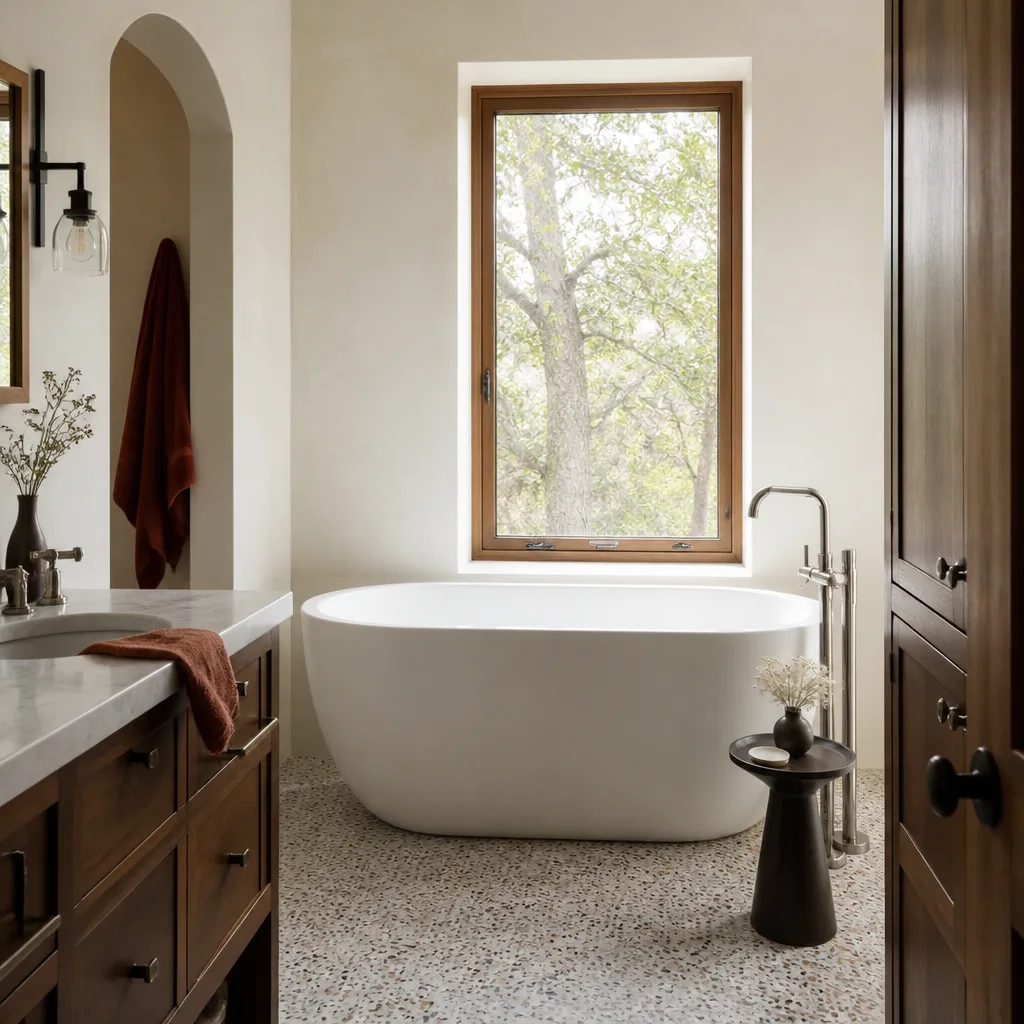
A primary bathroom remodel in San Jose runs $22,000 to $55,000 in 2026. A guest or hall bath runs $15,000 to $32,000. The spread is driven by whether you’re moving plumbing, replacing the shower pan, and what’s hiding behind the tile.
There’s a San Jose-specific reason the substrate matters more here than in a dry climate: our older housing stock from the 1950s through 1970s frequently has standard drywall behind original shower tile, not cement board or a waterproof membrane. Learn what to watch for in our Construction Warning Signs: A San Jose Homeowner’s Reference Guide. Once you pull the tile, that drywall is often compromised. In Almaden Valley and Willow Glen especially, we see this on nearly every original-condition bathroom. The repair is not optional, and it’s not something an out-of-market contractor’s estimate will include.
Here’s a line-item breakdown for a 60-square-foot primary bathroom with a tub-to-walk-in-shower conversion:
- Demolition and hauling: $1,800-$3,200.
- Cement board substrate and waterproofing (the moisture-resistant layer behind your tile): $1,500-$2,800. If you skip this line, walk away.
- Shower pan installation: $1,800-$3,500. A prefabricated pan costs less; a mud-set pan with tile costs more but lasts longer.
- Tile work, walls and floor: $4,000-$9,000. Large-format tile costs more per square foot to install because it requires more prep and slower setting.
- Vanity and countertop: $2,500-$6,000. Prefab vanities from big-box stores start around $700; semi-custom with a stone top runs higher.
- Plumbing fixtures (Kohler or Moen mid-tier): $1,200-$3,000. The delta between builder-grade and mid-tier is about $800 of product and no additional labor.
- Shower valve, trim, and supply line work: $1,000-$2,400. Moving the shower head or adding body sprays adds labor.
- Electrical (exhaust fan replacement or upgrade): $600-$1,800. San Jose code requires a bathroom exhaust fan vented to the exterior, not into the attic.
- Permits and inspections: $800-$1,800.
The takeaway: bathroom remodels in San Jose cost more than the national average because labor rates are higher and because old-house substrate repairs are a near guarantee. For a full look at scope, see our Bathroom Remodeling in San Jose page.
ADU Construction Costs in San Jose
San Jose has some of the most permissive ADU regulations in the Bay Area, which is why ADU construction keeps climbing. In 2026, a detached 500-square-foot one-bedroom ADU runs $250,000 to $380,000 all-in, including permits, utility connections, and site work. A 750-square-foot two-bedroom unit runs $320,000 to $450,000. Attached garage conversions run $120,000 to $200,000.
The per-square-foot number for an ADU is higher than for a room addition because an ADU is a full house in miniature: it needs its own kitchen, bath, electrical sub-panel, water heater, and often a separate sewer lateral connection. That last item alone can cost $8,000 to $20,000 in San Jose depending on the depth of the city main and whether your lot has a shared lateral.
What an ADU bid should contain:
- Site prep and foundation: $18,000-$35,000. Slab-on-grade is standard; pier-and-beam costs more if you’re on expansive soil.
- Framing, roofing, and exterior: $60,000-$110,000. James Hardie siding is common in San Jose and runs about $2,500-$4,500 more than stucco for a 500-square-foot unit, but it holds paint better in our wet winters.
- Rough and finish plumbing: $18,000-$32,000.
- Rough and finish electrical: $12,000-$22,000. A new 100-amp sub-panel is standard; if your main panel needs upgrading to 200 amps, add $3,500-$6,500.
- Kitchenette and bath finishes: $25,000-$45,000.
- Permit, plan check, school district fees, and park impact fees: $12,000-$28,000. San Jose charges school impact fees on new residential square footage; plan check on an ADU runs $2,000-$4,500.
If you’re considering an ADU as a rental, remember that San Jose requires the unit to be permitted and inspected before any tenant moves in. See Construction Permits, Codes & Inspections in CA: What You Need to Know for a deeper look at requirements. Unpermitted “granny flats” are common in older East San Jose and Evergreen neighborhoods, and they’re a liability at sale time and a code violation during occupancy.
Room Addition Costs: Per Square Foot Reality
Room additions in San Jose run $180 to $350 per square foot in 2026, with most primary-suite additions landing around $220 to $280 per square foot. But the per-square-foot number’s usefulness ends at the property line. What actually moves the total is the existing structure’s condition, the roofline tie-in, and the foundation approach.
A 400-square-foot primary suite addition in a typical San Jose ranch house breaks down like this:
- Foundation work: $15,000-$28,000. Post-tension slab tie-in is simpler; raised floor additions on crawl spaces require footing and pier work that costs more.
- Framing and roof tie-in: $35,000-$65,000. The roofline is the silent budget killer. A simple shed-roof tie is straightforward; matching a hip roof with two valley junctions adds $8,000-$15,000 in framing and roofing labor.
- Rough and finish electrical: $8,000-$16,000.
- Plumbing (for a bathroom addition): $12,000-$25,000. Running a new drain line across a slab foundation is the most expensive version of this work.
- Drywall, insulation, paint, and trim: $12,000-$22,000.
- Flooring and window packages: $8,000-$18,000. Milgard and Andersen are common in San Jose; the price gap between vinyl and fiberglass windows is about 40 percent.
- Permits, plan check, and inspections: $5,000-$12,000.
A 400-square-foot addition realistically lands between $95,000 and $186,000 all-in. Anyone quoting $60,000 for that scope is either doing illegal unpermitted work or planning to stop showing up halfway through.
The San Jose Permit and Plan-Check Layer Most Bids Omit
This is the part where out-of-market contractors and discount bidders quietly pad their margins. San Jose building permits, plan-check fees, and inspection costs are a real line item. In 2026, a kitchen remodel permit runs $1,800 to $3,500; a full ADU permit package with school district fees runs $12,000 to $28,000. Those numbers are not optional.
San Jose’s permit process works on a valuation-based fee model. The city calculates your project’s estimated construction value, then charges a percentage in building permit fees, electrical fees, plumbing fees, mechanical fees, and a plan-check fee that typically equals 65 percent of the building permit fee. On a $75,000 remodel, the permit package alone lands between $3,000 and $6,000 before you add school fees or park impact fees.
Here’s what a legal San Jose remodel requires:
- Building permit: covers structural changes, floor plan modifications, and egress requirements.
- Electrical, plumbing, and mechanical permits: each issued separately, each with its own inspection.
- Plan check: the city reviews your drawings before issuing the permit. Expedited plan check costs extra but cuts weeks off a kitchen remodel timeline.
- Inspections: rough-in inspections for electrical and plumbing, a framing inspection, and a final inspection. Each requires the work to be exposed at the right time.
One question to ask any San Jose contractor: “Is the permit line in your bid, and does it include plan check?” If the answer is no or a hedge, the number’s going to change somewhere between demo day and the final inspection.
This is the foundation of what we do as a General Contractor in San Jose: the written bid includes permits, plan check, and inspections, because the city requires them whether they’re in the bid or not.
Where San Jose Material Prices Beat the National Average by 15-30%
San Jose pays Bay Area premiums on several material categories, and you should understand where before you set your 2026 budget. The premium comes from three things: warehouse and distribution costs inside the 101-880 corridor, local union labor rates for material handling, and the fact that most San Jose homes were built before modern material standards, which means more prep work before new materials go in.
- Lumber and engineered wood products: 15-22 percent above national average. Framing packages for a room addition or ADU are the most visible place this shows up. A $6,000 national-average lumber package for a 400-square-foot addition runs $7,200-$7,400 delivered in San Jose.
- Tile and stone (excluding fabrication): 8-15 percent above national average. The product markup is modest, but San Jose tile setters command higher rates, and most local tile distributors price to the market, not the product list.
- Quartz and natural stone fabrication: 20-30 percent above national average when you include templating, cutting, and installation. A $55-per-square-foot fabricated quartz in Phoenix runs $70-$80 per square foot installed here. Cambria and Silestone material costs are similar nationwide; the labor and shop time are what move the needle.
- Cabinetry: 10-20 percent premium on semi-custom lines like KraftMaid and Wellborn due to freight, warehouse space, and installer rates. The same KraftMaid cabinet order costs more to deliver and install in San Jose than in Sacramento, and it’s not the product price that changes.
- Concrete and site work: 18-25 percent above national average. San Jose transfer station fees, dump costs, and aggregate delivery all carry premiums. Concrete that runs $140 a cubic yard in Texas runs $190-$220 here placed and finished.
What this means for your budget: if you’re comparing a San Jose bid to a national average calculator you found online, expect the local number to land 15 to 25 percent higher on the material side alone. That’s not a contractor markup. That’s the cost of building in a high-cost market.
Contingency Lines vs. Open-Ended Change Orders
Every legitimate San Jose remodel bid should contain a contingency line. It’s the honest way to handle the fact that no one knows what’s inside your walls until the walls come down. What separates a good bid from a blank check is how that contingency is structured.
A good contingency line looks like this: “10 percent contingency ($4,500) to be used only for documented, pre-approved conditions not visible at bid time, with written sign-off from owner before any draw.” A bad contingency looks like this: “Additional work as required will be billed at cost plus 20 percent.” The first one caps your exposure and gives you control. The second one is a blank check.
Here’s what a legitimate contingency line on a San Jose bid should specify:
- The percentage: typically 8 to 12 percent of total project cost for a remodel of an older home. Newer homes (post-1990) can safely run 5 to 8 percent.
- The approval process: any contingency draw requires a written, line-itemed explanation of what was found, what it costs, and your signature before work proceeds.
- The unused balance: if the contingency isn’t spent, you shouldn’t pay it. The bid should make that explicit.
We put the contingency in writing because we’ve seen what happens when it’s not. Trevor Nash has walked into too many half-finished San Jose kitchens where the homeowner’s $30,000 job became a $48,000 job with no paperwork explaining why. Not sure when to call a pro? Read our DIY vs Professional Construction: The San Jose Homeowner’s Decision Guide. That’s not how the Kingswell standard works. Say the price before the work. Put the change in writing before the change costs anything.
How to Compare Two Written Bids Line by Line
Most San Jose homeowners compare bids by looking at the bottom number. That’s a mistake, because two bids with the same bottom line can differ by $15,000 in scope. Here’s the comparison method we give to homeowners, stripped down to a process you can do at your kitchen table with two printed bids and a highlighter.
- Put both bids in the same format. Create a simple table: Line Item | Bid A | Bid B. Go through every line listed on both.
- Circle what’s missing from each bid. If Bid A includes a permit line and Bid B doesn’t, Bid B’s real number is higher than it appears. Add a $3,000-$6,000 placeholder for a kitchen remodel permit to any bid that omits it.
- Check cabinet and countertop specifics. “New cabinets” means nothing. Look for the cabinet line (KraftMaid, Wellborn, or custom?), the door style, the finish, and the countertop material and edge profile. A $12,000 cabinet allowance is not the same as $18,000 in specified cabinets with specified hardware.
- Compare the contingency language. If one bid has a capped contingency and one has cost-plus open language, the open one should be considered higher risk even if its base number is lower.
- Verify the warranty language. Ask what’s covered, for how long, and what happens if the work fails. A one-year workmanship warranty in writing is different from a verbal “we’ll take care of it.”
- Check payment schedules. California law caps deposits on home improvement contracts at the lesser of $1,000 or 10 percent. Anything more is illegal. A bid that asks for 30 percent upfront is a red flag.
We’re a general contractor that writes the price before the work starts, and we’d rather you compare our numbers honestly against anyone else’s than win a bid by leaving out what the other guy left in. For a look at how we scope and price projects from the first walkthrough, start at our Penhallow Remodeling San Jose home page.
Common Mistakes to Avoid
- Accepting a bid with no permit line. In San Jose, unpermitted work shows up at sale time and can tank a deal or force a retroactive permit application, which costs more than the original permit.
- Comparing only the bottom number. Two $40,000 kitchen bids can have $12,000 of scope difference once you line up cabinets, counters, permits, and contingency.
- Ignoring the substrate question. Older San Jose homes need drywall replacement behind tile. If the bid doesn’t mention cement board or a waterproof membrane, the bid isn’t complete.
- Signing a contract with open-ended change-order language. “Cost plus 20 percent” on unspecified work is how a $30,000 San Jose remodel becomes a $50,000 one.
- Paying too much upfront. California caps deposits at $1,000 for residential work. A contractor asking for 30 or 40 percent before demo day is either financially fragile or running a bad business.
- Not reading the warranty language. A written one-year workmanship warranty is standard and should be spelled out. A verbal promise isn’t worth the paper it’s not written on.
- Assuming national cost calculators apply to San Jose. Bay Area labor and material premiums add 15 to 30 percent to most line items, and local permit fees are a separate layer entirely.
See the difference
 Before
 After
After Before
 After
After Before
 After
AfterWhen to Call a Professional
If you’re planning a remodel that touches plumbing, electrical, or structural walls, this is not a weekend project, and it’s not something to hand to the lowest bidder. San Jose code requires licensed contractors to pull permits for this work, and a mistake in a shower pan or a kitchen subpanel is expensive to undo. If you have a written bid that doesn’t add up, or you want a second set of eyes on a scope of work before you sign, Penhallow Remodeling San Jose offers free estimates in San Jose. Call (669) 274-2362 and we’ll walk the project with you, line by line.
Frequently Asked Questions
A full kitchen remodel in San Jose runs $35,000 to $90,000 in 2026, with a cosmetic refresh (counters, cabinets refaced, backsplash) running $15,000 to $28,000. The biggest cost drivers are whether you move plumbing or electrical, which cabinet line you choose, and what condition the walls are in behind the old finishes. Call (669) 274-2362 for an exact quote on your kitchen.
Yes. Any structural change, any plumbing move or addition, and any electrical work requires a San Jose building permit plus the associated trade permits. A kitchen remodel permit package runs $1,800 to $3,500; a full ADU package with school district fees runs $12,000 to $28,000. Call (669) 274-2362 and we’ll confirm what your specific project requires.
On a San Jose remodel of a home built before 1990, a contingency of 8 to 12 percent of total project cost is standard and defensible. On a newer home, 5 to 8 percent is typical. The contingency should require written approval before any draw, and any unused balance should revert to you at the end of the job. Call (669) 274-2362 if you want help reviewing contingency language in a bid you’ve received.
A detached 500-square-foot ADU runs $250,000 to $380,000 all-in, while a 750-square-foot two-bedroom unit runs $320,000 to $450,000. Garage conversions run $120,000 to $200,000. Sewer lateral connections, school district fees, and a new electrical sub-panel are common line items that first-time ADU builders don’t expect. Call (669) 274-2362 for a written estimate on your ADU scope.
San Jose pays a 15 to 30 percent premium on most material categories and labor rates compared to national averages. Lumber runs 15 to 22 percent higher, tile and stone fabrication 20 to 30 percent higher, and concrete 18 to 25 percent higher. On top of that, San Jose’s permit and plan-check fees are a separate layer that most national cost calculators never include. Call (669) 274-2362 for a bid built from actual local material and labor pricing.
Line up both bids item by item and circle what’s missing from each. Check the permit line, the cabinet and countertop specifics, the contingency language, the warranty terms, and the payment schedule. The bid with the lower bottom number is often the one that omitted permits or substrate repair. Call (669) 274-2362 if you want a third written bid to check both against.
The Bottom Line
San Jose remodel costs in 2026 are real numbers with real drivers: labor makes up 40 to 55 percent of a project, materials 35 to 45 percent, and permit fees another 4 to 8 percent on top. A legitimate written bid itemizes those layers and caps the contingency at a percentage you approve before any draw. A bad bid hides the numbers you’ll find out about later. Compare bids line by line, check the warranty, and never sign a contract that asks for more than the legal $1,000 deposit. If you want a written number you can hold us to, call Penhallow Remodeling San Jose at (669) 274-2362. We’ll put the price, the permit line, and the 365-Day Done Right Promise in writing before a single cabinet gets pulled.
Written by Trevor Nash, Owner at Penhallow Remodeling San Jose, serving San Jose since 2004.


